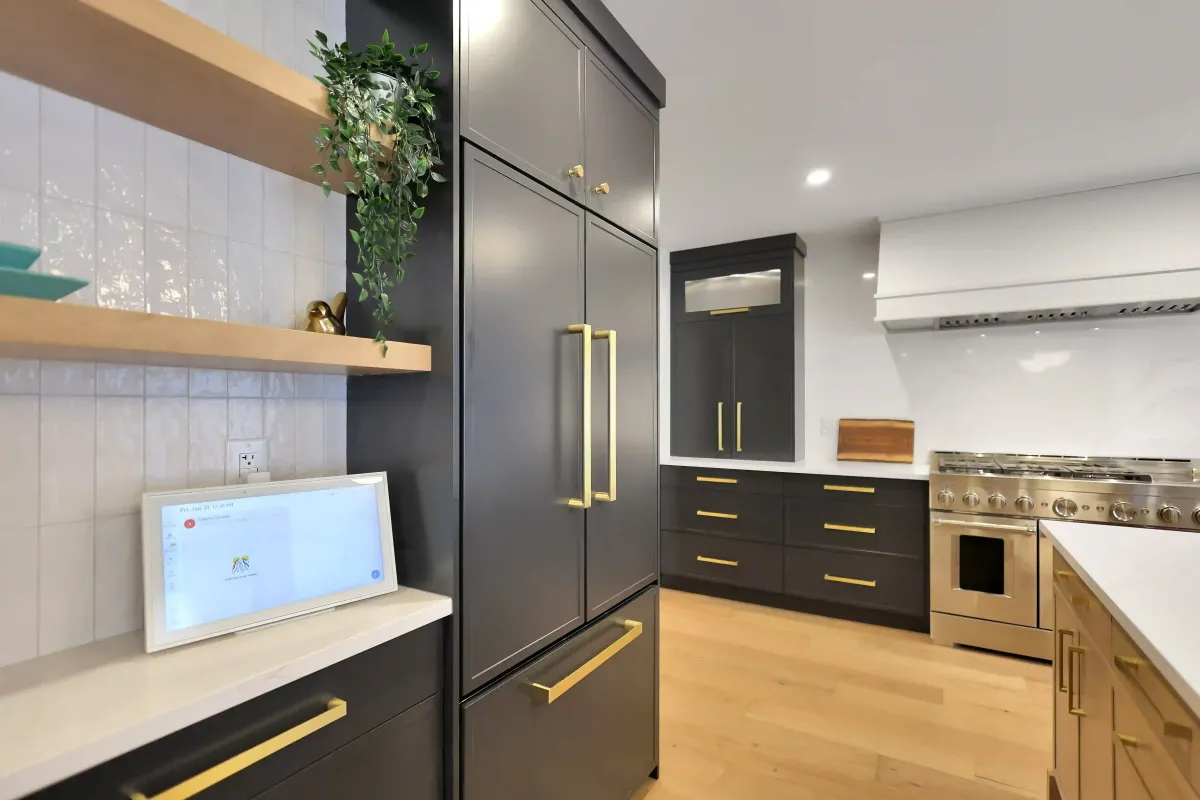
Is Custom Cabinetry Worth It? A Homeowner's Guide
Is Custom Cabinetry Worth It?
Stock, semi-custom, and fully custom cabinetry can look nearly identical in a showroom. The difference shows up later — in how well the storage actually works for your kitchen, and how long the cabinetry holds up under daily use. Here's what actually changes at each tier, so the decision isn't just about the number on the quote.
What Changes at Each Tier
Stock cabinetry comes in fixed sizes and a limited set of finishes, built in bulk ahead of time. It's the fastest and least expensive option, but your kitchen has to adapt to the cabinets' dimensions, not the other way around.
Semi-custom cabinetry starts from standard boxes but allows changes to width, height, and finish within a set range, along with more storage inserts and organizational options. It splits the difference — more flexibility than stock, without the full cost of a ground-up custom build.
Fully custom cabinetry is designed and built specifically for your space, dimension by dimension. Every inch of an awkward wall, an odd ceiling height, or an unusual appliance can be planned around rather than worked around.
Where Custom Actually Earns Its Cost
Custom cabinetry pays off most clearly when your kitchen has real constraints: an irregular layout, a narrow galley shape, a specific appliance that needs a non-standard opening, or a household with genuinely specific storage needs — a serious baking setup, a large collection of cookware, an accessibility requirement. In those situations, stock and semi-custom options either leave awkward gaps or force compromises that a custom build simply doesn't have to make.
It also earns its cost when the cabinetry is doing double duty as a design feature — a floor-to-ceiling pantry wall, a waterfall island, built-ins that flow into adjacent millwork. That level of integration is difficult to achieve with modular components.
Where Semi-Custom Is the Smarter Call
If your kitchen's layout is fairly standard and your main goal is better organization and a fresher look, semi-custom often delivers most of the practical benefit of a full custom build at a meaningfully lower cost. The gap between "good enough" and "worth the premium" is usually about how unusual your space or your storage needs actually are — not about wanting the nicest possible option on principle.
How This Fits a Renovation Budget
Cabinetry is one of the largest single line items in most kitchen renovations, which makes it worth deciding deliberately rather than defaulting to the highest tier available. A useful way to think about it: spend where standard options genuinely can't solve your problem, and treat the rest of the kitchen budget — counters, backsplash, lighting, appliances — as the place to balance it out.
Frequently Asked Questions
Does custom cabinetry always cost significantly more than semi-custom?
Generally yes, since it involves individual design and fabrication rather than modified standard components. The gap varies by project complexity, which is why an early conversation about layout and needs matters before committing to a tier.
Can I mix tiers in the same kitchen?
Yes. It's common to use custom cabinetry for a feature piece — an island, a pantry wall — and semi-custom for the rest of the kitchen.
How long does custom cabinetry take compared to stock?
Custom cabinetry has a longer lead time since it's built specifically for your space rather than pulled from existing inventory. This is worth factoring into your renovation schedule early.
Is custom cabinetry only about storage, or does it affect resale value too?
It primarily affects how well your kitchen functions day to day. Resale impact depends heavily on the broader renovation and the market, and shouldn't be the main reason to choose one tier over another.
Talk Through Your Kitchen's Real Constraints
If you're not sure which tier makes sense for your space, start a conversation with our team — we'll walk your kitchen and tell you honestly where custom cabinetry earns its cost and where it doesn't.